Serpentine minerals form where peridotite, dunite, and other ultramafic rocks undergo hydrothermal metamorphism. Ultramafic rocks are rare at Earth’s surface but are abundant at the oceanic moho, the boundary between the base of the oceanic crust and the upper mantle.
They are metamorphosed at convergent plate boundaries where an oceanic plate is pushed down into the mantle. This is where they are subjected to hydrothermal metamorphism. The source of water for this process is seawater entrained in the rocks and sediments of the oceanic slab.
During hydrothermal metamorphism, olivine and pyroxene minerals are transformed into or are replaced by serpentine minerals. Some of the metamorphic rocks produced here are composed almost entirely of serpentine minerals. These serpentine-rich rocks are known as “serpentinites.”
Extensive areas of Earth’s surface are underlain by serpentinites. These areas occur near present or ancient convergent plate boundaries. They are locations where remnants of an oceanic plate is exposed at the surface. The remnant portion of the plate was either thrusted up onto land, accreted onto the edge of a land mass, or exposed by uplift and deep weathering.
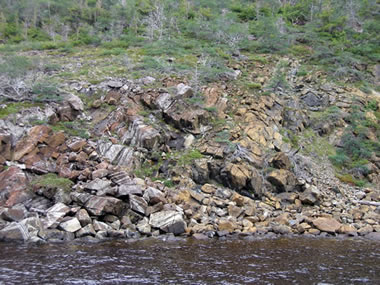
These areas of exposed oceanic plate are known as ophiolites. They are often the source of valuable minerals that might include magnetite, chromite, chrysoprase, jade, and serpentine.