Without question, the most spectacular geode deposit ever discovered is the amethyst amygdule basalts of Rio Grande do Sul region of Brazil and adjacent Uruguay. About 160 million years ago, when plate tectonic processes were rifting Africa and South America apart as the Atlantic Ocean opened, one of the world’s great flood basalt events was occurring. Basalts flowed from the rift, producing stratified lava flows thousands of feet thick.
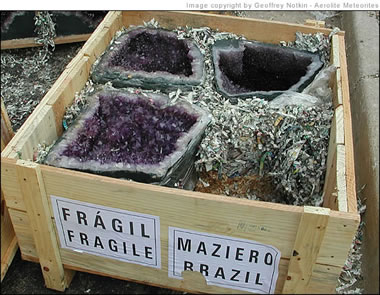
Within these flows, gas bubbles and lava tubes created cavities that were first lined by a layer of agate, and then by a complete covering of coarse crystalline quartz. At this point the geodes were formed, but they were filled with rock crystal instead of amethyst. However, as these geodes remained buried, they were irradiated by the decay of radioactive minerals in the surrounding basalts. This radiation created color centers in the quartz, and that transformed the clear quartz into amethyst. The resulting geodes are beautiful and some are enormous. Today they are carefully mined, sawn and made into display pieces that serve as gemmy decor in homes, offices and museums.
Some amethyst geodes are heated in a high temperature oven. This treatment causes the iron that is responsible for their purple color to oxidize. The result is a color transformation from amethyst quartz to citrine quartz.