A crystal containing both amethyst and citrine in contact with one another can be called “ametrine.” These crystals usually contain zones of clear quartz, amethyst, and citrine. When these crystals are cut into pieces that are appropriately sized for faceting gemstones, only a portion of the stones will be ametrine. The remainder will be amethyst, citrine, and clear quartz. This is why the Anahi Mine produces a variety of gem materials and why the amount of ametrine produced is limited.
Some of the early people involved in illicit production from the Anahi mine site were intent to produce amethyst and citrine. The novelty of a bicolor gemstone began when some lapidaries, inspired by bicolor tourmaline, began producing emerald-cut stones that were 50% amethyst and 50% citrine with the color boundary oriented perpendicular to the table of the stone. These stones were very attractive and desirable to people who saw them. The bicolor material then became a focus of production.
When Minerales y Metales del Oriente S.R.L. took over the mine, much of the production was being sold as cutting rough and mineral specimens. Since then the owner has worked to diversify revenue by developing the staff and facilities needed to cut the stones, design jewelry, manufacture jewelry, and market the rough, the loose stones, and finished jewelry. Now a large portion of the world’s ametrine gemstones are taken from the Earth and delivered to the end consumer through a few related companies located in Bolivia.
New methods of cutting have been developed to make maximum use of a finite ametrine resource. Some stones are still cut in the traditional emerald cut with a 50/50 amethyst/citrine split. Others are cut into “blended ametrine” that has random or planned patches of amethyst and citrine. These stones are cut in orientations that allow light penetrating the stone to pass through zones of purple amethyst and golden-yellow citrine. This can yield beautiful stones with face-up colors that include peach, magenta, and orange.
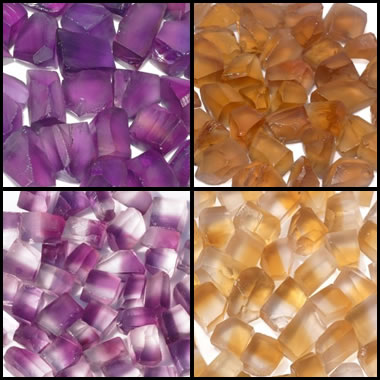
Byproducts of ametrine mining – amethyst, citrine, and bicolor stones: The Anahi Mine produces ametrine but also amethyst, citrine, bicolor amethyst and bicolor citrine. Samples of these materials are shown above. They are sawn to produce pieces that are ready for faceting.