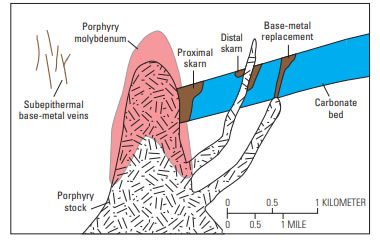
Most skarns form when carbonate rocks such as limestone, dolostone, or marble are intruded by a magma body and altered by contact metamorphism and metasomatism. At the time of intrusion, the heat of contact metamorphism is the primary agent of change.
Then, as the magma cools, it releases hot, acidic, silicate-rich fluids. Some magmas contain up to several percent dissolved water on the basis of weight, but because of the specific gravity difference between water and magma, the volume percent of dissolved water is at least twice the weight percent.
When this water is expelled from the magma, it is a solvent that has the ability to carry heat and chemically-active solutes into the country rock.
Water leaving the magma moves through the surrounding country rock by flowing or diffusing through pore spaces, fractures, and even the mineral grains that make up the rock. As it invades carbonate rock, the hot, acidic, metal-laden water dissolves, replaces, recrystallizes, and alters minerals in the carbonate rock.
These acidic waters are superheated and supersaturated with dissolved metal ions, especially calcium and silicon. As the acidic water moves through the carbonate rocks, its temperature falls and its acidity is neutralized. As this occurs, large amounts of calc-silicate minerals begin to precipitate in the carbonate country rock and change its composition.
Many different types of rock can be transformed into skarn by metasomatism. The original rock that is altered is known as the “protolith”. Although carbonate rock is the most common protolith, many skarns have formed in granite, basalt, conglomerate, tuff, shale, and other types of rock.