Basalt is also an abundant rock on the Moon. Much of the Moon’s surface is underlain by basaltic lava flows and flood basalts. These areas of the Moon are known as “lunar maria.” Large areas of the Moon have been resurfaced by extensive basalt flows which may have been triggered by major impact events. The ages of lunar maria can be estimated by observing the density of impact craters on their surface. Younger basalt flows will have fewer craters.
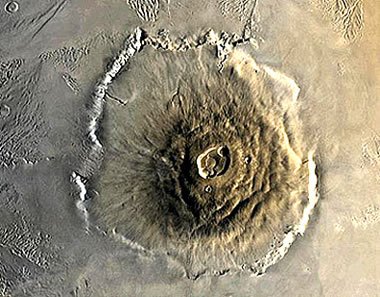
Olympus Mons is a shield volcano on Mars. It, like most other volcanic features on Mars, was formed from basaltic lava flows. It is the highest mountain on Mars and is the largest known volcano in our solar system.