For finding large quantities of crystals, the most successful mining method is to break into large cavities in the quarry walls and floors using sledge hammers and wedges (power equipment is not permitted at the mines listed in this article). This method requires tools, patience, time, and a knowledge of how to break an extremely durable dolostone.
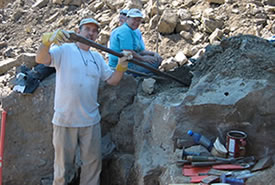
Photo copyright Bill McIlquham.
On a recent visit to the Ace of Diamonds Mine at Middleville, New York, we met Bill McIlquham of Peterborough, Ontario. Bill was mining for Herkimers with his wife Anne, their friend Laurie Mullett and mascot Duffy the Rockhound. They had located a large cavity and were carefully opening it. (Photos of their work shown here were kindly shared with Geology.com by Bill and fellow miners Cheryl Haberman and Alan Summer.)
The McIlquhams have been mining for Herkimers for about 12 years and have found many large cavities. A key element in their success is a nice array of hammers, wedges, and pry-bars. Instead of bashing the dolostone repeatedly with a hammer to break it into tiny pieces, Bill uses a sledge hammer and wedges to very carefully exploit existing fractures in the rock.
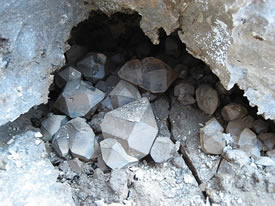
Photo copyright Bill McIlquham.
He begins by placing one wedge in a fracture and tapping it an inch or two deep. A second wedge is tapped into the fracture and additional wedges are used if needed. These wedges exert forces that penetrate into the rock and break large blocks of dolostone free. Fractures within the large dolostone blocks are then located and exploited until the large block has been reduced to smaller pieces that can be lifted from the quarry.
If a collector is lucky and determined to prevail over the durable dolostone, the reward could be breaking into a cavity. These cavities can contain a few to a few thousand nice “Herkimer diamonds” that range in size from a couple of millimeters to over twenty centimeters in size. Perfect single crystals, doubles and crystal clusters might all be found in a single cavity.
The cavity shown in the photos was opened by Anne and Bill. It contained over one hundred quartz crystals in a variety of sizes, ranging from a few millimeters to several centimeters in length. A very nice prize for a day’s work! Two large clusters from the cavity are shown on this page.