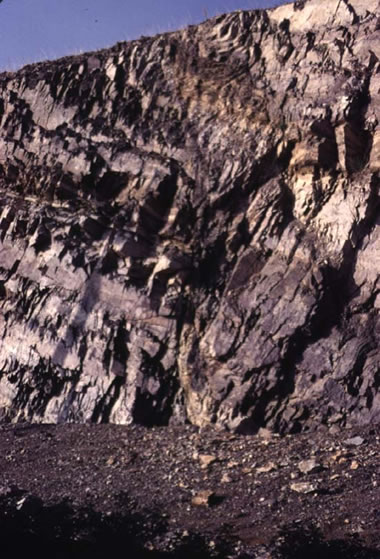
Hornfels often retains the stratification, large-scale geometry, and also some textural characteristics of the protolith. The changes of contact metamorphism that convert rocks to hornfels can include recrystallization, cementation, silicification, partial melting, and more.
The result is often a dense, hard, fine-grained rock that is generally homogenous and exhibits a semi-conchoidal fracture. Hornfels can be almost any color, but black, gray, brown, reddish and greenish rocks are common.
On the basis of mineral composition, most occurrences of hornfels can be separated into one of three general groups:
Pelitic Hornfels: usually derived from shale, slate, and schist
Carbonate Hornfels: usually derived from limestone, dolomite or marble
Mafic Hornfels: usually derived from mafic igneous rocks
A wide range of minerals and mineral groups are encountered in hornfels. The minerals frequently seen include: actinolite, andalusite, augite, biotite, calcite, chlorite, cordierite, diopside, epidote, feldspars, garnet, graphite, hornblende, kyanite, pyrite, scapolite, sillimanite, sphene, tourmaline, and vesuvianite.