In the mineralogical literature, the pink color of rose quartz has been attributed to titanium, manganese, and iron by a large number of authors for over 100 years. Tiny needles of rutile have been given credit for forming the six-ray star of rose quartz for the same amount of time.
In the late 1990s, an interesting investigation into the color and asterism of rose quartz was done by George Rossman, Julia Goreva, and Chi Ma at Caltech. They obtained samples of rose quartz from a number of localities throughout the world and gently dissolved them in hydrofluoric acid heated to 100 degrees Celsius. This treatment was intended to dissolve away the silicon dioxide of the quartz and any included material soluble in HF at 100 degrees Celsius.
In specimen after specimen, a tangle of extremely thin pink fibers remained after the acid treatment. They examined these fibers using scanning electron microscopy, infrared spectroscopy, Raman spectroscopy, optical absorption spectroscopy, and x-ray diffraction. Through this they determined that the pink fibers are a borosilicate with properties that are very similar to those of dumortierite. These investigators believe that the pink color and asterism of rose quartz is caused by these pink fibers that they have named dididumortierite.
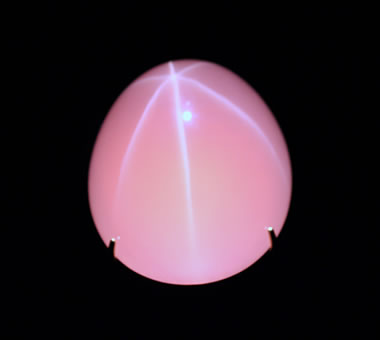
Star Rose Quartz: An oval-shaped cabochon of rose quartz exhibiting beautiful color and a spectacular six-ray star. This gem is from the collection of the Houston Museum of Natural Science.
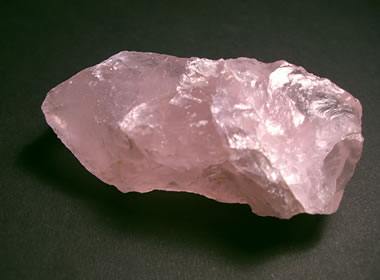
Rose Quartz Rough: A rough piece of rose quartz showing its conchoidal fracture, vitreous luster, translucence and pink color. This piece of rough has great color and would make nice cabochons, or beads, or be used to make tumbled stones in a rock tumbler.