Strontium titanate does not have the hardness and toughness of diamond, and that was a problem. It has a hardness of 5.5 — low enough that contact with many common objects could result in a scratch or a damaged facet edge. This deficiency allowed newly developed simulants a place in the market.
Starting in the 1970s, simulants such as YAG (yttrium aluminium garnet), GGG (gadolinium gallium garnet) and cubic zirconia (CZ) quickly took market share away from strontium titanate. In the eye of many consumers, these simulants had an appearance that was similar to diamond and a durability that was superior to strontium titanate.
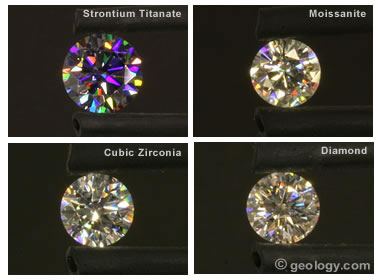
In the 1990s, synthetic moissanite began to replace YAG, GGG, and CZ in many of their uses. Its appearance is very similar to diamond, but it has a hardness and fire that is superior to all of these simulants from the 1970s. Cubic zirconia remains an important diamond simulant because its price is much lower than synthetic moissanite.
Today, strontium titanate is seldom seen in jewelry; however, it still has a more impressive fire than any natural or lab-created gemstone that is frequently seen in jewelry. It remains an attractive and satisfactory stone for earrings, pendants, and brooches that will encounter little abrasion or impact.
| Comparison of Diamond and Diamond Simulants | ||||
| Material | Refractive Index | Dispersion | Hardness | Popular During |
| Diamond | 2.417 | 0.044 | 10 | 1500s to present |
| Strontium Titanate | 2.41 | 0.190 | 5.5 | 1950s to 1970s |
| YAG | 1.83 | 0.028 | 8.3 | 1970s |
| GGG | 1.97 | 0.045 | 7 | 1970s |
| CZ | 2.2 | 0.06 | 8.3 | 1970s to present |
| Moissanite | 2.66 | 0.104 | 8.5 – 9 | 1990s to present |