Olivine is the name given to a group of silicate minerals that have a generalized chemical composition of A2SiO4. In that generalized composition, “A” is usually Mg or Fe, but in unusual situations can be Ca, Mn, or Ni.
The chemical composition of most olivine falls somewhere between pure forsterite (Mg2SiO4) and pure fayalite (Fe2SiO4). In that series, Mg and Fe can substitute freely for one another in the mineral’s atomic structure – in any ratio. This type of continuous compositional variation is known as a “solid solution” and is represented in a chemical formula as (Mg,Fe)2SiO4.
The name “olivine” is used instead of “forsterite” or “fayalite” because a chemical analysis or other detailed testing is needed to determine which one is dominant – if either is dominant. The name “olivine” serves as a quick, convenient, and inexpensive way to put a name on the material. A list of the more common olivine minerals and their composition is given in the table below.
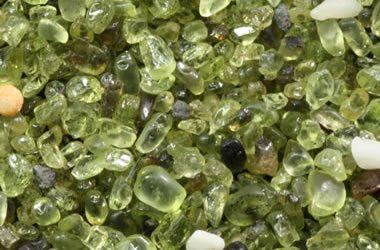
Olivine receives its name from its usual olive-green color. Many geology students remember the color of olivine by using a rhyme: “olivine is green.” That rhyme is true with most classroom specimens; however, there are rare iron-rich olivines (fayalites) that are brownish in color.