What is Diabase?
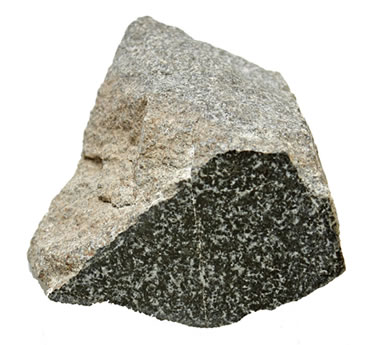
In the United States and Canada, the name “diabase” is used for a dark gray to black, fine-grained, intrusive igneous rock that has a composition similar to basalt and gabbro. The difference between basalt, diabase, and gabbro is in their grain size – which was determined by their cooling rates.
Basalt: rapid cooling in a lava flow produced individual crystals that are so small they are difficult to see with the unaided eye.
Diabase: slower cooling in shallow intrusions such as sills, dikes, lopoliths or laccoliths allowed individual crystals to grow slightly larger – up to about two millimeters in size.
Gabbro: slowest cooling below Earth’s surface gave crystals a longer time to grow – some may be over a centimeter across or larger.
In the United Kingdom and a few other countries, diabase is known as “dolerite”. The two words are synonyms.
Mineral Composition of Diabase
Diabase typically has a mineral composition that is dominated by the plagioclase feldspar known as labradorite (approximately 40% to 70% of the rock). Most of the remainder is made up of pyroxene minerals (usually augite). Minor amounts of hornblende, olivine, magnetite, and quartz can be found in some diabase rocks.
Although the mineral species present in diabase often have perfect cleavage, when they are present in tiny interlocking grains, the cleavage is usually not an important durability concern when the rock is used as a construction material.
Here are two facts about diabase and its commercial use:
1) The plagioclase in diabase is often of the labradorite variety. Diabase from some quarries contains abundant crystals of labradorite that are capable of producing colorful reflections known as “labradorescence”. When cut and polished, this diabase can serve as an attractive architectural stone.
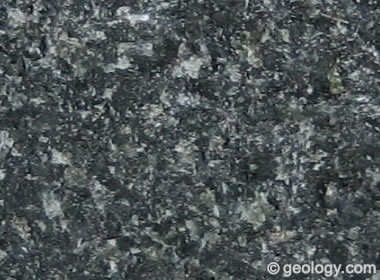
2) The pyroxene minerals in diabase, as well as the feldspars, will form a weathering rind when exposed to the elements. So, an initially black construction stone can alter to a chalky white, gray, or tan color. This should be expected unless the stone has been polished, treated, or used in a location not exposed to the elements.
Diabase Porphyry
Some igneous rocks have a complex cooling history that results in them containing grains of distinctly different crystal sizes. These rocks, with large crystals (known as “phenocrysts”) suspended in a matrix of fine crystals (known as “groundmass”), often have a cooling history similar to the following description:
The parent magma of the rock began cooling slowly, deep underground, and some large crystals of minerals with a high crystallization temperature began to form there. The magma was then erupted to the surface or moved to a shallow location, such as a dike or sill, where the next, and often the final, part of its cooling occurred. The cooling rate at this shallow depth was faster and the groundmass of the rock is composed of small crystals of minerals that have a lower cooling temperature.
Much diabase contains two distinctly different crystal sizes and is known as “diabase porphyry”. When cut and polished, it can make an interesting and attractive stone for use in tiles, countertops, window sills, stair treads, facing stone or other uses.
Problems Identifying Diabase
The fine-grained texture of diabase makes identification in the field or in a classroom a difficult undertaking. The observer must have enough skill to view the physical properties of tiny mineral grains, and enough knowledge to identify the minerals. Getting a confident identification in these locations can be difficult.
Diabase is best identified in thin section with a petrographic microscope, with x-ray diffraction, or with other instruments that can identify the component minerals and their relative abundances. So, many people take the easy way out and call the unknown specimen “trap rock” (a layman’s name that fits a number of dark, fine-grained igneous rocks) or take a chance of declaring an incorrect scientific name. When you hear the name “diabase”, you should examine the rock to confirm its identity, if the name of the rock is important.