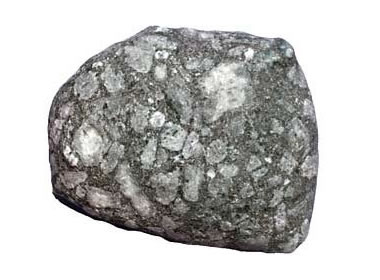
Some igneous rocks have a complex cooling history that results in them containing grains of distinctly different crystal sizes. These rocks, with large crystals (known as “phenocrysts”) suspended in a matrix of fine crystals (known as “groundmass”), often have a cooling history similar to the following description:
The parent magma of the rock began cooling slowly, deep underground, and some large crystals of minerals with a high crystallization temperature began to form there. The magma was then erupted to the surface or moved to a shallow location, such as a dike or sill, where the next, and often the final, part of its cooling occurred. The cooling rate at this shallow depth was faster and the groundmass of the rock is composed of small crystals of minerals that have a lower cooling temperature.
Much diabase contains two distinctly different crystal sizes and is known as “diabase porphyry”. When cut and polished, it can make an interesting and attractive stone for use in tiles, countertops, window sills, stair treads, facing stone or other uses.