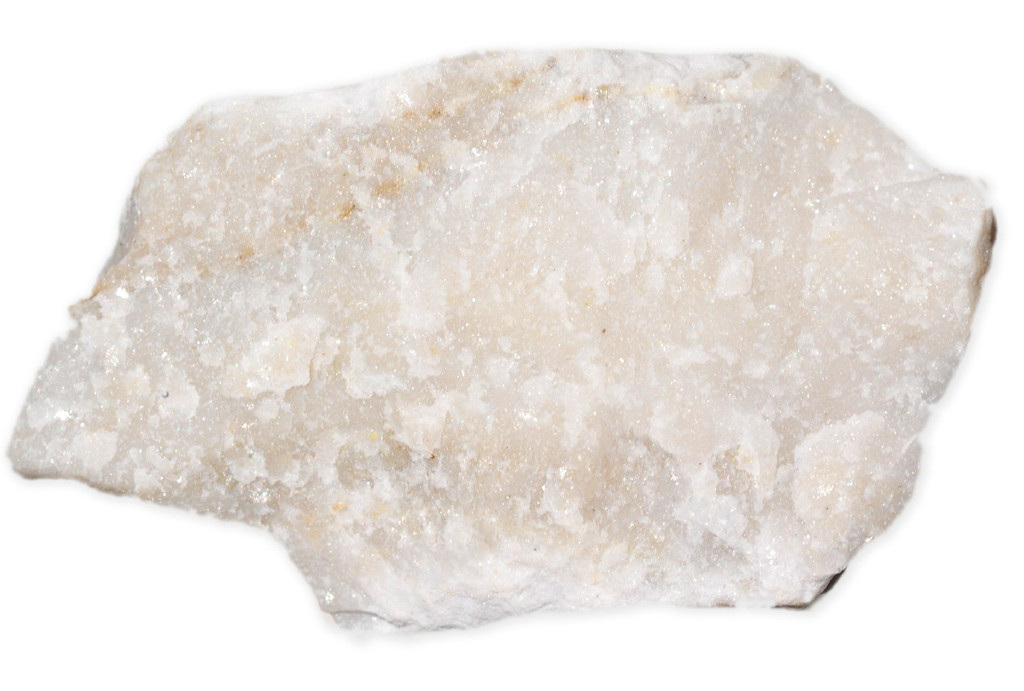
Dolomite is very common in the rock record, but the mineral dolomite is rarely observed forming in sedimentary environments. For this reason it is believed that most dolomites form when lime muds or limestones are modified by postdepositional chemical change.
Dolomite originates in the same sedimentary environments as limestone – warm, shallow, marine environments where calcium carbonate mud accumulates in the form of shell debris, fecal material, coral fragments, and carbonate precipitates. Dolomite is thought to form when the calcite (CaCO3) in carbonate mud or limestone is modified by magnesium-rich groundwater. The available magnesium facilitates the conversion of calcite into dolomite (CaMg(CO3)2). This chemical change is known as “dolomitization.” Dolomitization can completely alter a limestone into a dolomite, or it can partially alter the rock to form a “dolomitic limestone.”