Many Ethiopian opals are sold in their natural state, and some are treated. Their porosity makes them good candidates for dye, smoke, and sugar/acid treatments. All of these treatments, when disclosed, reduce the price of the opal to much less than natural opal with the same appearance. When undisclosed they can deceive inexperienced buyers and sometimes even experienced buyers.
Dye Treatment:
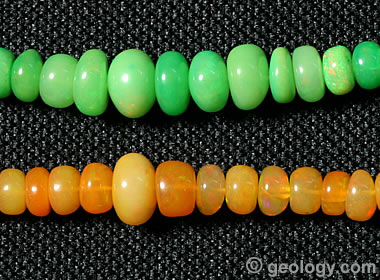
Hydrophane opals, like those found in Ethiopia, are easy to dye because their porosity naturally absorbs liquids. People who know opal can identify dyed opal on-sight when an outrageous color is used. However, the practice of slightly enhancing an opal’s body color with dye can be much less obvious. In these cases, dye treatments can often be detected with microscopic examination or by cutting into the opal to see if the color is concentrated near the surface.
Some large buyers of cut opal or finished jewelry require vendors to provide samples of the opal rough when making large purchases. The samples are used for testing and comparison to assure that the finished stones and jewelry they are purchasing have not been treated. Color enhancements can increase the marketability and price of the opal if not obvious or disclosed. For this reason, if a buyer wants natural-color opal, testing to confirm that the color is not caused by dye is important.
Smoke Treatment:
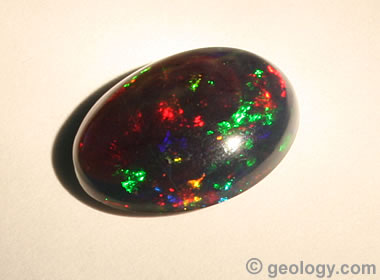
Smoke is a suspension of very fine particles in air or gas. Fine smoke particles can enter the pore spaces of opal and change its body color. The smoke treatment can be done by wrapping the opal in paper and heating the paper to a temperature that produces smoldering. The smoldering paper releases fine particles of black soot that enter the pores of the opal and darken its body color. The darker body color contrasts with the opal’s play-of-color, making it appear stronger and more obvious.
Smoke treatment can sometimes be detected by looking for black soot particles during microscopic examination. These can often be seen individually, or in concentrations along microfractures within the opal. Laboratory tests, such as Raman spectroscopy, have the ability to detect smoke treatment because they can detect carbon, which is normally absent in opals of volcanic origin.
Sugar/Acid Treatment:
The sugar/acid treatment is done by soaking opal for a few days in a warm solution of sugar water, then submerging the opal in sulfuric acid. The acid oxidizes the sugar in the pore spaces of the opal, producing dark-colored carbon particles and stains. This imparts or darkens a gray, black, or brown body color in the opal. Like smoke treatment, these can often be detected by microscopic examination or by laboratory tests for carbon.