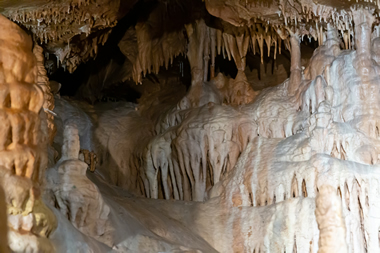
Limestone can also form through evaporation. Stalactites, stalagmites, and other cave formations (often called “speleothems”) are examples of limestone that formed through evaporation.
In a cave, droplets of water seeping down from above enter the cave through fractures or other pore spaces in the cave ceiling. There they might evaporate before falling to the cave floor.
When the water evaporates, any calcium carbonate that was dissolved in the water will be deposited. Over time, this evaporative process can result in an accumulation of icicle-shaped calcium carbonate on the cave ceiling. These features are known as stalactites.
If droplets fall to the floor and evaporate there, stalagmites could eventually grow upwards from the cave floor.
The limestone that makes up these cave formations is known as “travertine,” a chemical sedimentary rock. A rock known as “tufa” is a limestone formed by evaporation at a hot spring or on the shoreline of a lake in an arid area.