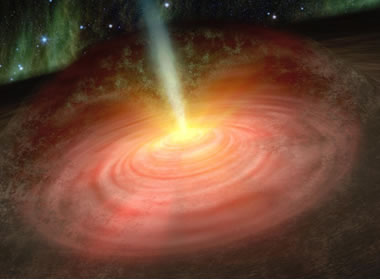
The crystals are in the form of forsterite. They belong to the olivine family of silicate minerals and can be found everywhere from a peridot gemstone to the green sand beaches of Hawaii to remote galaxies. NASA’s Stardust and Deep Impact missions both detected the crystals in their close-up studies of comets.
“If you could somehow transport yourself inside this protostar’s collapsing gas cloud, it would be very dark,” said Charles Poteet, lead author of the new study, also from the University of Toledo. “But the tiny crystals might catch whatever light is present, resulting in a green sparkle against a black, dusty backdrop.”
Forsterite crystals were spotted before in the swirling, planet-forming disks that surround young stars. The discovery of the crystals in the outer collapsing cloud of a proto-star is surprising because of the cloud’s colder temperatures, about minus 280 degrees Fahrenheit (minus 170 degrees Celsius). This led the team of astronomers to speculate the jets may in fact be transporting the cooked-up crystals to the chilly outer cloud.
The findings might also explain why comets, which form in the frigid outskirts of our solar system, contain the same type of crystals. Comets are born in regions where water is frozen, much colder than the searing temperatures needed to form the crystals, approximately 1,300 degrees Fahrenheit (700 degrees Celsius). The leading theory on how comets acquired the crystals is that materials in our young solar system mingled together in a planet-forming disk. In this scenario, materials that formed near the sun, such as the crystals, eventually migrated out to the outer, cooler regions of the solar system.