The most commonly encountered minerals in the garnet group include almandine, pyrope, spessartine, andradite, grossular, and uvarovite. They all have a vitreous luster, a transparent-to-translucent diaphaneity, a brittle tenacity, and a lack of cleavage. They can be found as individual crystals, stream-worn pebbles, granular aggregates, and massive occurrences. Their chemical composition, specific gravity, hardness, and colors are listed below.
| Garnet Minerals | ||||
| Mineral | Composition | Specific Gravity | Hardness | Colors |
| Almandine | Fe3Al2(SiO4)3 | 4.20 | 7 – 7.5 | red, brown |
| Pyrope | Mg3Al2(SiO4)3 | 3.56 | 7 – 7.5 | red to purple |
| Spessartine | Mn3Al2(SiO4)3 | 4.18 | 6.5 – 7.5 | orange to red to brown |
| Andradite | Ca3Fe2(SiO4)3 | 3.90 | 6.5 – 7 | green, yellow, black |
| Grossular | Ca3Al2(SiO4)3 | 3.57 | 6.5 – 7.5 | green, yellow, red, pink, clear |
| Uvarovite | Ca3Cr2(SiO4)3 | 3.85 | 6.5 – 7 | green |
| The compositions listed above are for end members of several solid solution series. There are a number of other garnet minerals that are less frequently encountered and not as important in industrial use. They include goldmanite, kimzeyite, morimotoite, schorlomite, hydrogrossular, hibschite, katoite, knorringite, majorite, and calderite. |
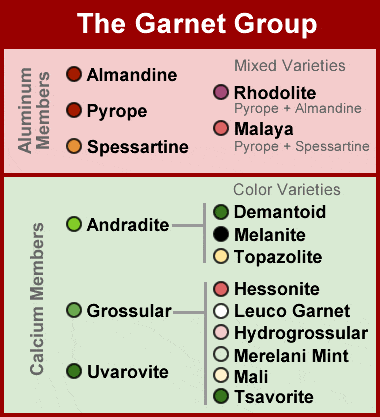
As seen above, there are a variety of different types of garnet, and each has a different chemical composition. There are also solid solution series between most of the garnet minerals. This wide variation in chemistry determines many of their physical properties. As an example, the calcium garnets generally have a lower specific gravity, a lower hardness and are typically green in color. In contrast, the iron and manganese garnets have a higher specific gravity, a greater hardness and are typically red in color.
| Physical Properties of Garnet | |
| Chemical Classification | Silicate |
| Color | Typically red, but can be orange, green, yellow, purple, black, or brown. Blue garnets are extremely rare. |
| Streak | Colorless |
| Luster | Vitreous |
| Diaphaneity | Transparent to translucent |
| Cleavage | None |
| Mohs Hardness | 6.5 to 7.5 |
| Specific Gravity | 3.5 to 4.3 |
| Diagnostic Properties | Hardness, specific gravity, isometric crystal form, lack of cleavage |
| Chemical Composition | General formula: X3Y2(SiO4)3 |
| Crystal System | Isometric |
| Uses | Waterjet cutting granules, abrasive blasting granules, filtration granules, abrasive grits and powders, gemstones |