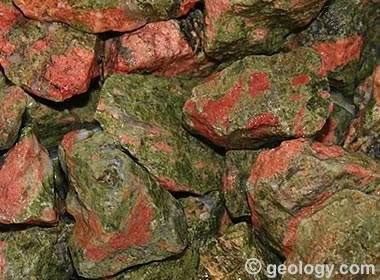
Unakite is not seen in fine jewelry and is seldom seen in commercial jewelry, but it is a common stone used in craft and lapidary jewelry. It is usually cut into cabochons, beads, pendants, or freeform shapes.
Unweathered, fine-grained unakite with mineral crystals less than a few millimeters in size is relatively easy to work. It is suitable for cutting by a person who has a small amount of lapidary experience. The Mohs hardness of the primary minerals (epidote = 6 to 7; orthoclase = 6) are close enough that severe undercutting or overcutting usually does not occur. It is only when the grain size is larger, or the piece being cut is very small, that differences in hardness will make cutting difficult.
Unakite cuts best using diamond abrasives but can also be cut or tumbled using silicon carbide abrasives. It polishes well with inexpensive aluminum oxide polish, but tin oxide, cerium oxide, and titanium oxide also produce good results on a felt lap or in a rock tumbler.
In jewelry projects, unakite works best in pieces that will not be subjected to abrasion or impact. The hardness of orthoclase and epidote are low enough that they will show signs of wear when used in a bracelet or ring. These minerals also have perfect cleavage and could break with a moderate impact.