Geodes, nodules, vugs, concretions and thundereggs are all sites in the earth where substances dissolved in subsurface waters precipitate to form crystals or rounded objects. These objects share many common features and form by similar processes. They all also produce objects that attract attention and stimulate debate. These objects are often confused with one another, and their names are used incorrectly because the speaker misunderstands the words or interprets the object incorrectly. They are also used in different ways by different people in various parts of the world. Who is right and who is wrong? Some generalizations drawn from the common usage of these words are offered below…
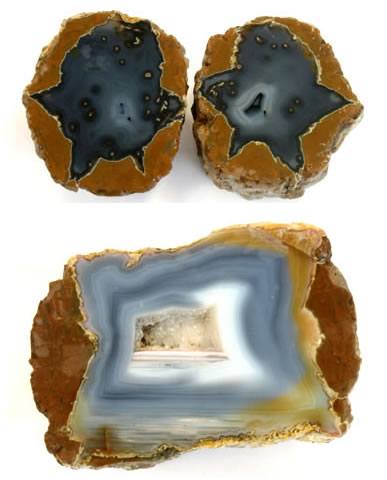
- Geodes have a hollow space inside, or once had a hollow space inside that was filled with precipitated mineral material. The precipitated mineral materials filled the cavity mainly through concentric inward growth. They have a competent external lining that allows them to separate from their host rock. This competent external lining allows many geodes to separate and survive after the host rock has been completely disintegrated by weathering. The geodes can then be collected from the land surface, dug from the soil, or found in stream beds.
- Nodules are solid objects composed of precipitated mineral material. They may have been hollow (and a geode) at one time, then completely filled with precipitated mineral material. They might also have formed by mineral growth on a sediment surface, growth within a cavity, or by replacement of their host rock.
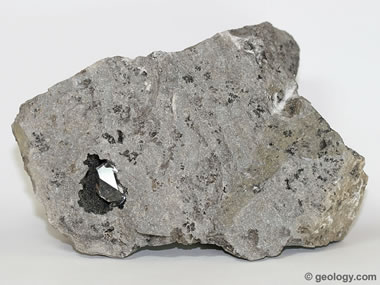
- Vugs are cavities that might contain crystals, but they do not have a competent lining that allows them to separate from their host rock. Unlike many geodes, they probably will not exist after the host rock is weathered away.
- Concretions are solid aggregates composed of sediment grains and a cementing material. They form when chemical precipitation begins around a nucleus in the sediment, such as a fossil or a mineral grain. More and more material accumulates around the nucleus, and the concretion grows in three dimensions by filling in pore spaces and/or replacing mineral grains. Their growth starts in the center and they enlarge outwards without a cavity, whereas geode growth begins in a cavity and the minerals grow inwards.
- Thundereggs are spherical to subspherical masses of rhyolite that weather out of volcanic strata. They have an internal cavity that has been infilled with agate, opal or other mineral material. Thundereggs rarely contain mineral crystals growing into a void.