Most people immediately think of China as the source of jade and jade objects. China has always been an important producer of jade, a leading jade cutting center, jade consumer, and jade market. The only time dominance in these activities moved outside of China was between World War II and the early 1980s. At that time the Chinese government suppressed jade commerce, and Hong Kong temporarily became the center of jade commerce.
Jade jewelry and jade artwork are extremely important in China. Jade is more important in China than the importance of diamonds in the United States. Per-carat prices for the best imperial jade in China rival the per-carat price paid for diamonds in the United States.
Since prehistoric times, jade has been used to make tools, weapons, and important ornamental objects in Asia, Europe, Australia, North America, South America, and numerous Pacific islands. The toughness of jade made it an excellent material for making tools and weapons.
Because of its beauty, people held jade in highest esteem and used it to make religious art and ornaments for their rulers. None of these ancient cultures had contact with one another, yet they all independently used jade for many of their most sacred and important objects. Such is the appeal of jade.
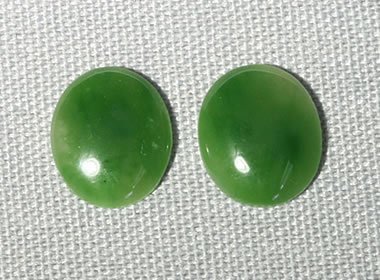
British Columbia jade cabochons: A pair of translucent cabochons cut from bright green British Columbia nephrite. Approximately 10 x 12 millimeters in size. Today, tons of jade are mined in British Columbia and shipped to China, where both demand and prices are higher than in western Canada.