The formation of rhodochrosite usually occurs in fractures and cavities of metamorphic and sedimentary rocks. It is often associated with silver deposits, and a few silver mines produce rhodochrosite as a byproduct. Some of the common modes of occurrence and their lapidary uses are described below.
In metamorphic rocks, rhodochrosite is found as a vein and fracture-filling mineral where it precipitates from ascending hydrothermal solutions. Repeated episodes of crystallization allow it to build up in layers on the walls of the fracture. Each layer can be a unique precipitation event and produce material with a slightly different pink color. This gives character to the material for lapidary use.
Miners usually remove the rhodochrosite from the wall rock of these veins and cut it into thin slabs with a diamond saw. The slabs can then be used to make cabochons, small boxes, or other lapidary projects.
Some rhodochrosite forms in cavities in sedimentary and metamorphic rocks when descending solutions deliver a supply of dissolved materials. In these deposits, the rhodochrosite accumulates in layers on the walls of the cavity and may form stalactites and stalagmites on the roof and floor of the cavity – just like speleothems in a cavern.
These formations are often removed and slabbed to produce material with concentric pink banding. Some of the best examples of this form of rhodochrosite are found at the Capillitas and Catamarca deposits in Argentina.
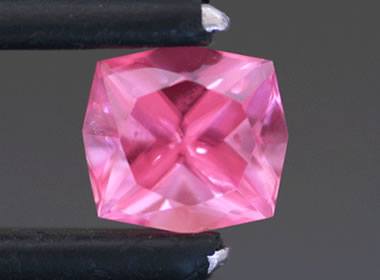
Rhodochrosite is extremely rare as well-formed crystals. One of the few locations in the world where they are found is the Sweet Home Mine, near Alma, Colorado. Originally opened as a silver mine in 1873, the rhodochrosite was disregarded at that time. Then, as the popularity of mineral collecting increased, the well-formed crystals found at the Sweet Home Mine became many times more valuable than the lapidary material. Excellent, small, hand-size specimens currently sell for five-digit numbers. Broken or damaged crystals are sometimes used as faceting rough.
Rhodochrosite for lapidary and mineral specimen use is only found in a few locations worldwide. These include Argentina, South Africa, Peru, Montana, Colorado, Russia, Romania, Spain, China, Gabon, Mexico, and Japan.