Tourmaline most commonly occurs as an accessory mineral in igneous and metamorphic rocks. Large, well-formed crystals of tourmaline can form in cavities and fractures during hydrothermal activity. Tourmaline is a hard and tenacious mineral. That enables it to persist during stream and beach transport as durable grains in sediments and sedimentary rocks.
Tourmaline Crystals
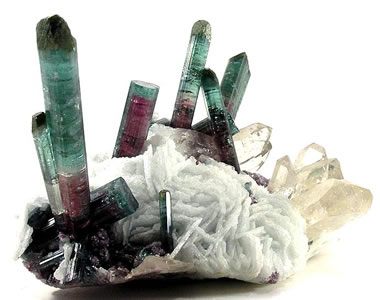
The most spectacular tourmaline crystals are formed by hydrothermal activity. These crystals form when hot waters and vapors carry the elements needed to form tourmaline into pockets, voids, and fractures, which offer an open space for crystal growth. The tourmaline crystals formed in these cavities range in size from tiny millimeter crystals to massive prisms weighing over 100 kilograms.
One rich pocket of nice tourmaline crystals can yield mineral specimens and gem materials worth millions of dollars. Many mineral collectors and gem hunters have become wealthy by discovering just one of these treasure-filled cavities.