Variscite is rarely found in crystals that are large enough to see without magnification. Instead it usually occurs in cryptocrystalline masses, nodules, veins, or cavity fillings. These usually form as a secondary mineral in near-surface deposits where phosphate-bearing waters interact with minerals that contain aluminum.
In the United States, variscite is found in Nevada, Utah, and Wyoming. It is also found in Australia, Brazil, Germany, Poland, and Spain. Variscite is often found in the same geographic areas as turquoise, and this can result in variscite being incorrectly identified as turquoise.
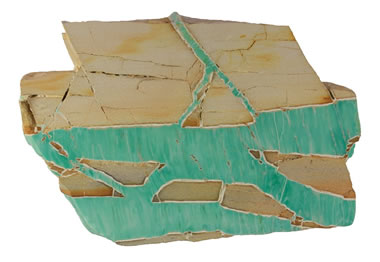
Variscite fracture fillings: Variscite has filled the fractures in this piece of siltstone. This specimen is from Queensland, Australia, and measures 4.3 inches (11 cm) across. Creative Commons image by Siim Sepp.
| Physical Properties of Variscite | |
| Chemical Classification | Phosphate |
| Color | Typically yellowish green to slightly bluish green, often with yellow, brown or black matrix. Also known to be yellowish brown to brownish yellow. |
| Streak | White |
| Luster | Waxy, subvitreous |
| Diaphaneity | Opaque |
| Cleavage | Cleavage is rarely visible because variscite usually occurs in microcrystalline aggregates. |
| Mohs Hardness | 3.5 to 5 |
| Specific Gravity | 2.6 |
| Diagnostic Properties | Color, concretionary habit with matrix, refractive index, spectra, Chelsea filter reaction. |
| Chemical Composition | Hydrated aluminum phosphate, AlPO4•2H2O |
| Crystal System | Orthorhombic |
| Uses | Cut into gemstones for collectors; used for jewelry, small sculptures, and ornamental projects |