The USGS assessed undiscovered copper in two deposit types that account for about 80 percent of the world’s copper supply. Porphyry copper deposits account for about 60 percent of the world’s copper. In porphyry copper deposits, copper ore minerals are disseminated in igneous intrusions. Sediment-hosted stratabound copper deposits, in which copper is concentrated in layers in sedimentary rocks, account for about 20 percent of the world’s identified copper resources. Globally, mines in these two deposit types produce about 12 million tons of copper per year.
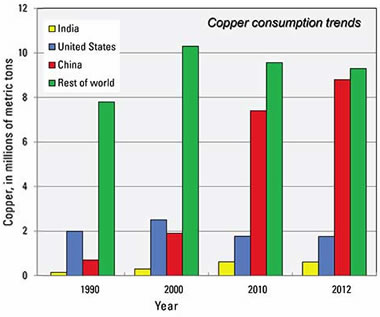
This study considered potential for exposed and concealed deposits within 1 kilometer of the surface for porphyry deposits and up to 2.5 kilometers of the surface for sediment-hosted stratabound deposits. For porphyry deposits, 175 tracts were delineated; 114 tracts contain 1 or more identified deposits. Fifty tracts were delineated for sediment-hosted stratabound copper deposits; 27 contain 1 or more identified deposits.
Results of the assessment are provided by deposit type for 11 regions (see Copper Deposit Map on this page). The mean total undiscovered resource for porphyry deposits is 3,100 million tons, and the mean total undiscovered resource for sediment-hosted deposits is 400 million tons, for a global total of 3,500 million tons of copper. The ranges of resource estimates (between the 90th and 10th percentiles) reflect the geologic uncertainty in the assessment process. Approximately 50 percent of the global total occurs in South America, South Central Asia and Indochina, and North America combined.
South America has the largest identified and undiscovered copper resources (about 20 percent of the total undiscovered amount). The world’s largest porphyry deposits are mined in this region. Chile and Peru are among the world’s top copper-producing countries.
Central America and the Caribbean host two undeveloped giant (>2 million tons copper) porphyry copper deposits in Panama. Most of the undiscovered resources are in a belt that extends from Panama to southwestern Mexico.
North America hosts highly mineralized porphyry copper tracts that include supergiant (>25 million tons copper) porphyry deposits in northern Mexico, the western United States, and Alaska, as well as giant deposits in western Canada. The estimated undiscovered porphyry copper resources are approximately equal to the identified resources.
The leading copper-producing states in the U.S.A. are Arizona, Utah, New Mexico, Nevada, and Montana. In the United States, undiscovered sediment-hosted stratabound copper deposits in Michigan, Montana, and Texas are estimated to contain about three times as much copper as has been identified. Two giant deposits are known, in Michigan and Montana.
Northeast Asia is relatively underexplored, with modest identified porphyry copper resources and only one identified giant porphyry copper deposit. However, the mean undiscovered resources are estimated to be quite large. This region has the largest ratio of undiscovered to identified resources in the study.
North Central Asia has 35 porphyry copper deposits, including a supergiant deposit in Mongolia and a giant deposit in Kazakhstan. The tract area is estimated to contain about three times the amount of identified porphyry copper resource. This region also hosts three giant sediment-hosted stratabound copper deposits, in Kazakhstan and Russia. The USGS estimates that as much sediment-hosted stratabound copper as has already been discovered may be present.
South Central Asia and Indochina are less thoroughly explored than many other parts of the world; however, four giant porphyry copper deposits have been identified to date in the Tibetan Plateau. Undiscovered porphyry copper deposits may contain eight times the identified amount of copper.
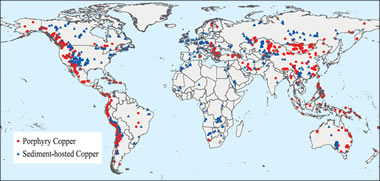
Southeast Asia Archipelagos host world-class, gold-rich porphyry copper deposits such as a supergiant in Indonesia and about 16 giant deposits in Indonesia, Papua New Guinea, and the Philippines. Although parts of the region are well explored, undiscovered porphyry resources are likely to exceed identified resources.
Eastern Australia has one giant porphyry copper deposit and several small porphyry deposits. Modest undiscovered resources are expected under cover. Australia has been a leading copper producer for decades.
Eastern Europe and Southwestern Asia have been mined for copper since ancient times, and giant porphyry copper deposits have recently been identified. Undiscovered copper is predicted to be about twice the identified resources, both for porphyry deposits along a belt from Romania through Turkey and Iran and for sediment-hosted stratabound deposits in Afghanistan.
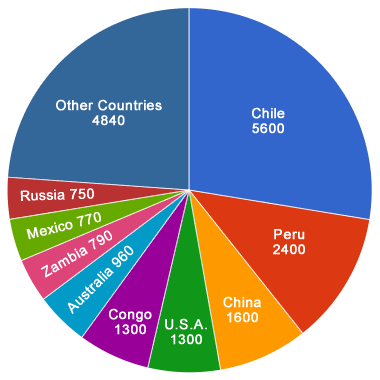
Western Europe has the largest sediment-hosted stratabound copper deposit in the world, in Poland. Undiscovered sediment-hosted stratabound copper resources in southwestern Poland are estimated to exceed identified resources by about 30 percent.
Africa and the Middle East have the world’s largest accumulation of sediment-hosted stratabound copper deposits, with 19 giant deposits in the Central African Copper belt in the Democratic Republic of Congo and Zambia. Significant undiscovered copper resources remain to be discovered.