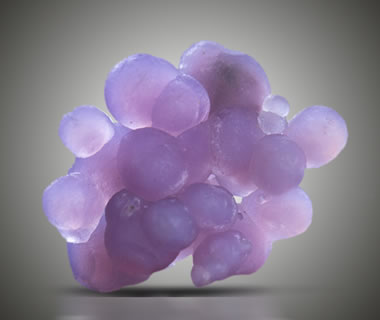
In 2016, mineral dealers began selling specimens of “grape agate”. The specimens were composed of tiny purple spheres that ranged in size between about 2 and 8 millimeters across (see accompanying photo). The specimens were called “grape agate” because of their purple color, their botryoidal habit (from the Greek botrys, meaning a “bunch of grapes”), and because of their translucent appearance. “Grape agate” quickly became a popular new mineral specimen because of its wonderful color, fun name, and interesting appearance.
However, a few people questioned the identity of the material, doubting that agate was the proper name. When it was noticed that the grapes had a drusy surface (drusy means “covered with crystals”), the identity of “agate” was realized to be incorrect. Why? Because agate, as a variety of chalcedony, has a microcrystalline texture, while common quartz has a crystal size that can be recognized with the unaided eye or with only a low level of magnification.
Although specimens of this material are still called “grape agate”, a more appropriate name is “botryoidal amethyst”. In the gem and mineral trade, incorrect names such as “grape agate” are called “misnomers”.