According to legend, the Ayoreo Indian tribe of eastern Bolivia knew about the bicolor quartz crystals over 500 years ago. Perhaps the earliest formal documentation of natural quartz crystals with zonal coloring of purple and yellow is in a 1925 issue of American Mineralogist. These were basal sections of quartz crystals with color sectors alternating between purple and yellow.
Reports of a quartz gemstone of mixed purple and yellow color being produced anywhere in the world begin in the 1960s from vague localities in Brazil, Bolivia, and Uruguay. Because the material was not attributed to a specific mine, some people believed it was produced synthetically, produced by treating amethyst, or mined illicitly.
In 1989, changes to Bolivian mining laws allowed gemstone mining in eastern Bolivia, and a company, Minerales y Metales del Oriente S.R.L., obtained exclusive mining rights to a few thousand acres. Their property included a mine location with evidence of a long history of illicit mining. To establish credibility in the gemstone trade, the company invited geologists and gemologists to the mine and allowed them to confirm for themselves that the ametrine and citrine produced there were natural.
Today, their Anahi Mine is the world’s only important commercial source of natural ametrine and anahite (a clear variety of quartz with a very light tint of lilac). The mine also produces amethyst, citrine, and bicolor materials that are a combination of amethyst and clear quartz (bicolor amethyst) or citrine and clear quartz (bicolor citrine).
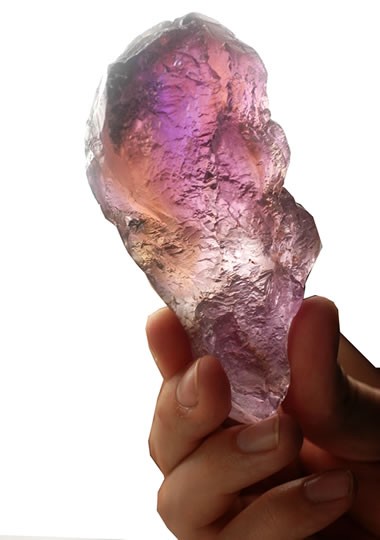
Ametrine crystal from the Anahi Mine in Bolivia.