Fire opals are cut in a variety of ways. Some are cut as faceted stones, others are cut as cabochons. The cutter decides how he/she thinks the stone will be most attractive. There is no rule for cutting fire opal.
Transparent fire opals are most often faceted so that they can be illuminated by incident light. If they have a spectacular play-of-color, they might be cut into a cabochon like most precious opal. If the play-of-color is minor, it might be cut into a faceted stone with a little surprise of flash.
Translucent stones are often cut into cabochons, but it is not unusual to see a translucent to nearly opaque fire opal with an attractive color cut into a pretty faceted stone. The three faceted stones in the photo above are wonderful examples of translucent stones that have been faceted.
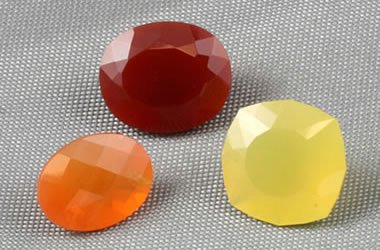
The orange stone is about 7 x 9 millimeters in size and was mined in Oregon. Fire opal of this color is sometimes called “tangerine opal”.
The red stone is about 8 x 10 millimeters in size and was mined in Mexico. Fire opal of this color is often called “cherry opal”.
The yellow stone is about 9 millimeters across and was mined in Nevada. Fire opal of this color is sometimes called “lemon opal”.