Chert can form when microcrystals of silicon dioxide grow within soft sediments that will become limestone or chalk. In these sediments, enormous numbers of silicon dioxide microcrystals grow into irregularly-shaped nodules or concretions when dissolved silica is transported to the formation site by the movement of groundwater.
If the nodules or concretions are numerous, they can grow large enough to merge with one another to form a nearly continuous layer of chert within the sediment mass. Chert formed in this manner is a chemical sedimentary rock.
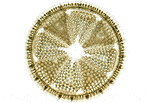 Diatoms are microscopic, single-celled algae that live in marine or fresh water. They produce hard parts made of silicon dioxide. NASA Image. |
Some of the silicon dioxide in chert is thought to have a biological origin. In some parts of the ocean and in shallow seas, large numbers of diatoms and radiolarians live in the water. These organisms have a glassy silica skeleton. Some sponges also produce “spicules” that are composed of silica.
When these organisms die, their silica skeletons fall to the bottom, dissolve, recrystallize, and might become part of a chert nodule. In some areas the sedimentation rate of these materials is high enough to produce rock layers that are thick and laterally extensive. Chert formed in this way could be considered a biological sedimentary rock.