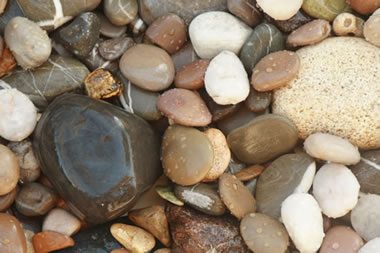
Conglomerate forms where sediments of rounded clasts at least two millimeters in diameter accumulate. It takes a strong water current to transport and produce a rounded shape on particles this large. Wind transport is unlikely to produce a conglomerate.
The environment of deposition might be along a swiftly flowing stream or a beach with strong waves. These conditions might only be met during times of extreme flow or wave action. However, it is during these times that much of the Earth’s sediments are picked up, moved, and deposited.
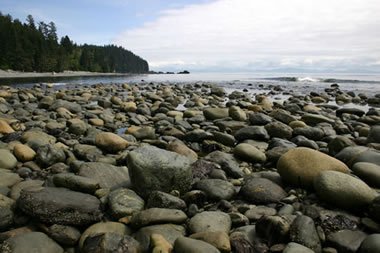
To form a conglomerate, there must also be a source of large-size sediment particles somewhere up current. The rounded shape of the clasts reveals that they were tumbled for some distance by running water or moving waves. These conditions are found in streams, lakes, and oceans in many parts of the world.
Conglomerates often begin when a sediment consisting mainly of pebble- and cobble-size clasts is being deposited. The finer-size sand and clay, which fill the spaces between the larger clasts, is often deposited later on top of the large clasts and then sifts down between them to fill the interstitial spaces. After compaction, the precipitation of a chemical cement between the grains will bind the sediment into a rock.