Garnet in Metamorphic Rocks
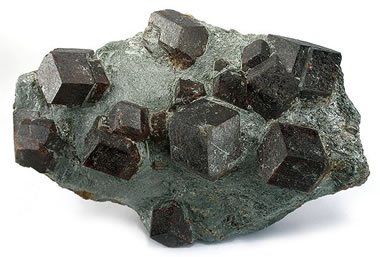
Most garnet forms at convergent plate boundaries where shale is being acted upon by regional metamorphism. The heat and pressure of metamorphism breaks chemical bonds and causes minerals to recrystallize into structures that are stable under the new temperature-pressure environment. The aluminum garnet, almandine, generally forms in this environment.
As these rocks are metamorphosed, the garnets start as tiny grains and enlarge slowly over time as metamorphism progresses. As they grow, they displace, replace, and include the surrounding rock materials. The photo below shows a microscopic view of a garnet grain that has grown within a schist matrix. It included a number of the host rock’s mineral grains as it grew. This explains why so many garnets formed by regional metamorphism are highly included.
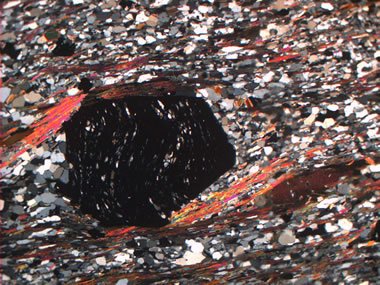
Garnet mica schist in thin section: This is a microscopic view of a garnet grain that has grown in schist. The large black grain is the garnet, the red elongate grains are mica flakes. The black, gray, and white grains are mostly silt or smaller size grains of quartz and feldspar. The garnet has grown by replacing, displacing, and including the mineral grains of the surrounding rock. You can see many of these grains as inclusions within the garnet. From this photo it is easy to understand why clean, gem-quality garnets with no inclusions are very hard to find. It is also hard to understand how garnet can grow into nice euhedral crystals under these conditions.
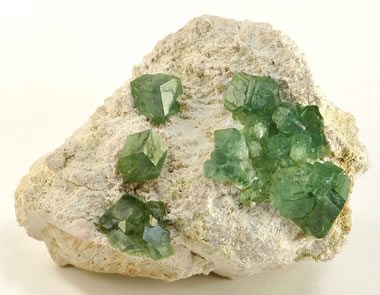
The calcium garnets typically form when argillaceous limestone is altered into marble by contact metamorphism along the edges of igneous intrusions. These are andradite, grossular, and uvarovite, the slightly softer, typically green garnets with a lower specific gravity. Two calcium garnets are highly regarded in the gem trade; they are tsavorite (a bright green grossular) and demantoid (a golden-green andradite).
Garnet is a common mineral in skarns. Skarns are metamorphic rocks that have been chemically and mineralogically altered by metasomatism. In the metasomatism process, hot, chemically active fluids flow through the rocks to cause recrystallization and compositional change. Skarns are usually rich in garnet, pyroxene minerals, carbonate minerals, and quartz.
ADVERTISEMENTGarnet in Igneous Rocks
Garnet often occurs as an accessory mineral in igneous rocks such as granite. Many people are familiar with almandine garnet because it is sometimes seen as dark red crystals in the igneous rocks used as granite countertops. Spessartine is an orange garnet found as crystals in granite pegmatites. Pyrope is a red garnet that is brought to Earth’s surface in pieces of peridotite that were torn from the mantle during deep-source volcanic eruptions. Garnet is also found in basaltic lava flows.
Garnet in Sedimentary Rocks and Sediments
Garnets are relatively durable minerals. They are often found concentrated in the soils and sediments that form when garnet-bearing rocks are weathered and eroded. These alluvial garnets are often the target of mining operations because they are easy to mine and remove from the sediment/soil by mechanical processing.