Gneiss usually forms by regional metamorphism at convergent plate boundaries. It is a high-grade metamorphic rock in which mineral grains recrystallized under intense heat and pressure.
This alteration increased the size of the mineral grains and segregated them into bands, a transformation which made the rock and its minerals more stable in their metamorphic environment.
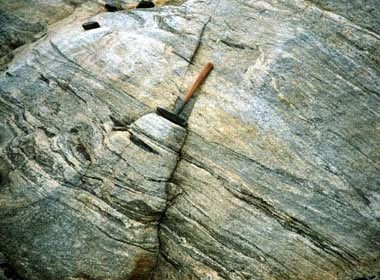
Gneiss can form in several different ways. The most common path begins with shale, which is a sedimentary rock. Regional metamorphism can transform shale into slate, then phyllite, then schist, and finally into gneiss.
During this transformation, clay particles in shale transform into micas and increase in size. Finally, the platy micas begin to recrystallize into granular minerals. The appearance of granular minerals is what marks the transition into gneiss.
Intense heat and pressure can also metamorphose granite into a banded rock known as “granite gneiss.” This transformation is usually more of a structural change than a mineralogical transformation.