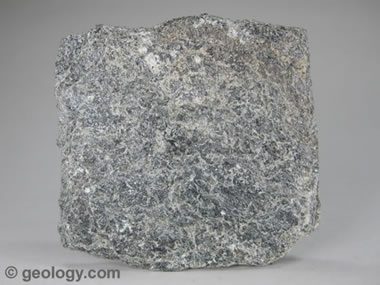
Schist is a rock that has been exposed to a moderate level of heat and a moderate level of pressure. Let’s trace its formation from its protoliths – the sedimentary rocks from which it forms. These are usually shales or mudstones.
In the convergent plate boundary environment, heat and chemical activity transform the clay minerals of shales and mudstones into platy mica minerals such as muscovite, biotite, and chlorite. The directed pressure pushes the transforming clay minerals from their random orientations into a common parallel alignment where the long axes of the platy minerals are oriented perpendicular to the direction of the compressive force. This transformation of minerals marks the point in the rock’s history when it is no longer sedimentary but becomes the low-grade metamorphic rock known as “slate.”
Slate is has a dull luster, it can be split into thin sheets along the parallel mineral alignments, and the thin sheets will ring when they are dropped onto a hard surface. If the slate is exposed to additional metamorphism, the mica grains in the rock will begin to grow. The grains will elongate in a direction that is perpendicular to the direction of compressive force. This alignment and increase in mica grain size gives the rock a silky luster. At that point the rock can be called a “phyllite.” When the platy mineral grains have grown large enough to be seen with the unaided eye, the rock can be called “schist.” Additional heat, pressure, and chemical activity might convert the schist into a granular metamorphic rock known as “gneiss.”