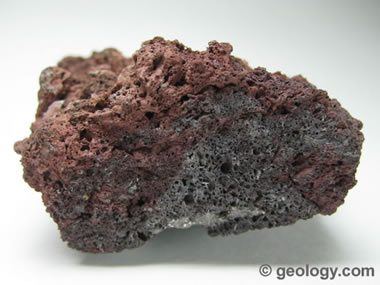
Scoria forms when magma containing abundant dissolved gas flows from a volcano or is blown out during an eruption. As the molten rock emerges from the Earth, the pressure upon it is reduced and the dissolved gas starts to escape in the form of bubbles. If the molten rock solidifies before the gas has escaped, the bubbles become small rounded or elongated cavities in the rock. This dark-colored igneous rock with the trapped bubbles is known as scoria.
When some volcanoes erupt, a rush of gas blows out of the vent. This gas was once dissolved in the magma below. The gas often blows out small bodies of magma that solidify as they fly through the air. This action can produce a ground cover of scoria all around the volcanic vent, with the heaviest deposits on the downwind side.
Small particles of scoria that litter the landscape around the volcano are known as “lapilli” if they are between 2 millimeters and 64 millimeters in size. Larger particles are known as “blocks.”