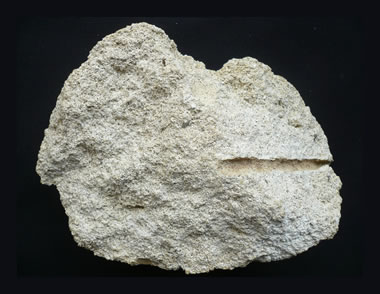
The keys to identifying chalk are its hardness, its fossil content, and its acid reaction. At a glance, diatomite and gypsum rock have a similar appearance. An examination with a hand lens will often reveal the fossil content, separating it from gypsum. Its reaction with dilute (5%) hydrochloric acid will separate it from both gypsum and diatomite.
The acid reaction will surprise you if you are used to testing other types of limestone and have never tested chalk. When you apply a drop of acid, capillary action pulls it deep into pore spaces of the specimen. There, the enormous surface area of calcium carbonate that contacts the drop of acid usually produces a spectacular effervescence. Instead of holding the specimen in your hand during the test, place it on surface that will not be damaged by the acid, with a couple paper towels beneath it. You don’t want to have the specimen in your hand and be startled by the effervescence.