Apollo astronauts found ilmenite-rich basalts at multiple locations on the Moon. Most of these basalts were extremely old, forming at least 3 billion years ago. These rocks often contained over 10% titanium dioxide (TiO2). Minerals present in these rocks were mostly feldspars and pyroxenes, with ilmenite next in abundance.
Some samples of lunar regolith contained significant amounts of ilmenite. It occurred in particles ranging from fine silt to coarse sand. The ilmenite was thought to have been liberated from lunar basalts during impact events.
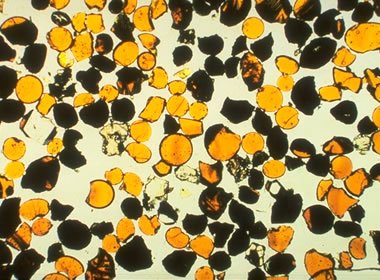
Samples of lunar regolith collected at Shorty Crater contained a mix of volcanic glass spheres and ilmenite grains. The deposit was stratified with a bottom layer composed mostly of ilmenite and other black opaque materials. This graded upwards to an upper layer, known as “orange soil,” that was composed mostly of spherical-shaped beads of orange volcanic glass with minor amounts of ilmenite. The grains were mostly less than 1/2 millimeter in size. This regolith was thought to have been produced by fountaining volcanic eruptions during the early lunar history.