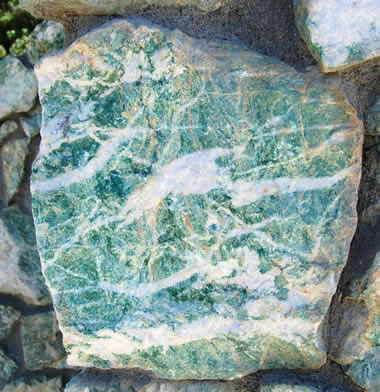
The name “mariposite” has appeared in the geological literature since the late 1800s. “Mariposite” is not the name of a formally recognized mineral. Instead, it is an informal name that has been widely used for various types of mica with a green color. Green micas are often called “mariposite,” which implies that an identification has been made. It would probably be better to simply call the material “green mica.”
Making a positive identification, to the species level, of tiny grains of mica in the field can be difficult to impossible. It was problematic in a well-equipped lab in the late 1800s and early 1900s. Even today, positive identification can require chemical, mineralogical, or microscopic testing by an experienced mineralogist.
Examples of how the name “mariposite” has been used between 1897 and 2010 in publications of the United States Geological Survey are given below:
 “mariposite (a green mica containing a small amount of chromium)” “a chromium mica which is probably mariposite” “the chromiferous potassium mica mariposite” “chlorite and a yellowish sericite are erroneously identified as mariposite” “mariposite — a green chromiferous sericite” “Mariposite can be identified only by means of chemical and microscopical tests, ordinary visual identification is worthless.” “Mariposite, the chromian phengite” “fuchsite/mariposite” “chromium mica (?mariposite? in older literature)” “[the] distinctive green mica, which has been referred to by the varietal names mariposite and fuchsite is most appropriately classified as chromian phengite” “mariposite (a green mica containing a small amount of chromium)” “a chromium mica which is probably mariposite” “the chromiferous potassium mica mariposite” “chlorite and a yellowish sericite are erroneously identified as mariposite” “mariposite — a green chromiferous sericite” “Mariposite can be identified only by means of chemical and microscopical tests, ordinary visual identification is worthless.” “Mariposite, the chromian phengite” “fuchsite/mariposite” “chromium mica (?mariposite? in older literature)” “[the] distinctive green mica, which has been referred to by the varietal names mariposite and fuchsite is most appropriately classified as chromian phengite” |
Clearly, the name “mariposite” has been used many ways. This lack of consistent use probably contributes to “mariposite” being called a “discredited name” in the Glossary of Geology, Fifth Edition, published by the American Geosciences Institute.