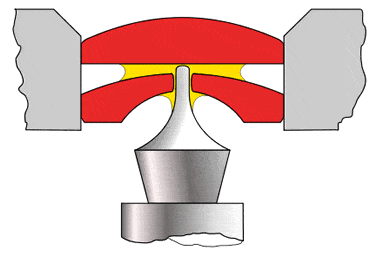
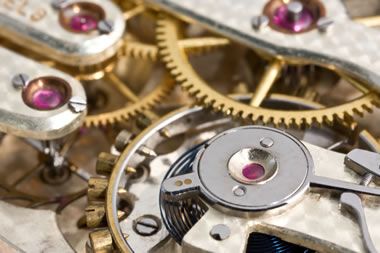
In the mid-1800s, watch makers in Switzerland needed tiny bearings that were highly resistant to abrasion. They discovered that they could drill a hole into a tiny piece of corundum and use it for a smooth-running, long-life bearing. The corundum was much harder than the metals used to make the moving parts of a watch, and it was able to stand up to the continuous abrasion without failing. The corundum bearings were called “jewel bearings” after their gemstone counterparts.
Swiss watches and their “jewel movements” became famous throughout the world for their long life and reliability. In the early 1900s, synthetic corundum bearings replaced natural corundum bearings in most Swiss watches. Synthetic corundum was more uniform than natural corundum as well as being cheaper and easier to obtain. This use of jewel bearings created a positive reputation for Swiss watches that continues to this day – even while mechanical watches are being replaced by digital watches.
Colorless synthetic sapphire is also used in watches. Its durability, vitreous luster, and resistance to being scratched makes it a perfect transparent covering for the face of a mechanical or digital. These clear covers, known as “crystals” protect the face of the watch from impact, dust, moisture and abrasion. Synthetic sapphire has been used for this purpose for nearly 100 years.