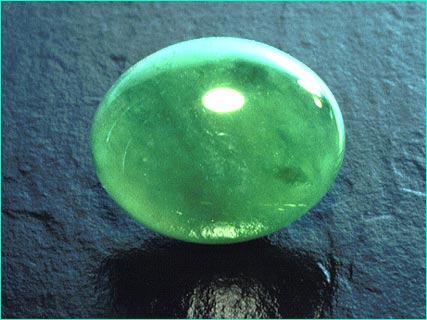
A number of other minerals and materials that are commonly cut and polished are easily confused with jade. All of these materials can have a color, luster, and translucence that is very similar to jade – so similar that the average person is unable to recognize them. These materials are often used to manufacture cabochons, beads, and other objects in the same style as jade. They sometimes enter the market with and without disclosure. They are often marked with the name “jade” or with one of many misnomers.
Chalcedony is a translucent variety of microcrystalline quartz that occurs in a range of colors similar to jade. Chrysoprase is a bright green chalcedony colored by chromium that, when cut into cabochons, beads, and small sculptures, will look very similar to jade. Chalcedony occurs in a variety of other translucent colors such as black, lavender, yellow, and orange that can look like the color varieties of jade. Chalcedony can be a very close gemstone look-alike with jade. It can be differentiated from jade using is lower specific gravity and by a variety of instrumental methods.
Commonly Confused With Jade: Pictured here are four gems commonly confused with jade. From top left and going clockwise they are chrysoprase, maw sit sit, serpentine, and hydrogrossular garnet. They have a color, luster, and translucence that is known to occur in jade.
Serpentine occurs in a variety of wonderful translucent to nearly transparent green and yellowish green colors that look very much like jade. It is a metamorphic mineral that is often found in the same geographic areas and same types of rocks as jade. Serpentine is significantly softer than jade and also has a much lower specific gravity.
Vesuvianite, also known as idocrase, is another jade look-alike that is very difficult to distinguish from jade without laboratory testing. It has similar hardness, specific gravity, and physical appearance. Vesuvianite is not nearly as tough as jade and will break more easily – but that requires destruction of the specimen.

Vesuvianite has a color and a greasy luster that fool unknowing people into thinking it is nephrite.
Maw Sit Sit is a rock with a bright chrome-green color mined in Myanmar. It has a very similar appearance to jade. Maw sit sit is composed of jadeite, albite, and kosmochlor (a mineral related to jadeite). It is used to cut cabochons, beads, and make small sculptures, and is easily confused with jade.
Hydrogrossular Garnet is a green massive variety of garnet that is usually green in color with black markings. It looks so much like jade that in South Africa, where it is common, it is known as “Transvaal Jade.” It is frequently cut into beads, cabochons, and small sculptures.
Aventurine is a trade name used for a green quartz that is often colored by fuchsite inclusions. These typically color the quartz a light to dark green color and produce some aventurescent sparkle. Aventurine is sometimes confused with jade. It is sometimes referred to by the misnomer of “Indian Jade.”
All of the above natural minerals and rocks can be confused with jade. Many people like them, enjoy them, and knowingly purchase them for that reason. It is important to know that these jade look-alikes, along with plastic and glass made into objects in the same style as jade, are abundant in the market place. Know what you are buying or purchase from a dealer you can trust if you are shopping for these items and desire jade instead of an alternative. Errors and deception are common.