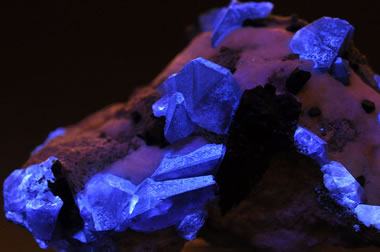
The benitoite occurs with neptunite in crusts, seams, and thicker deposits of white natrolite on the walls of geode-like cavities and fissures in the hornblende schist. These deposits occur in both irregularly shaped masses and in seams with more definite directions. They inclose fragments of hornblende schist which has been heavily impregnated with natrolite. In some of the inclusions the gradation from the hornblende rock containing much natrolite to natrolite containing acicular inclusions of hornblende is complete. The benitoite is embedded in or attached to natrolite, being in some places completely, in other places partly, enveloped by it. In the latter places the benitoite projects into the cavities along with the coarse drusy surfaces of the natrolite. Natrolite with or without benitoite and neptunite fills some of the fissures and former cavities completely. The benitoite is always in contact with natrolite and has not been found embedded in the hornblende rock alone. It is in many places attached to hornblende impregnated with natrolite and is partly or completely inclosed in natrolite on the remaining sides. The neptunite is subject to the same relations with the natrolite and is, in places, partly surrounded by benitoite. These facts point to the same period of formation for the three minerals with the power of crystallization arranged in the following order: neptunite, benitoite, and natrolite.