The word “granite” is used in a variety of ways by different people.
A simple definition is used in introductory geology or earth science courses.
A more precise definition is used by petrologists (geologists who specialize in the study of rocks).
And, the definition of granite expands wildly when used in the crushed stone and dimension stone industries.
These multiple definitions of granite can lead to communication problems. However, if you know who is using the word and who they are communicating with, you can interpret the word in its proper context. Three common usages of the word “granite” are explained below.
A) Introductory Course Definition
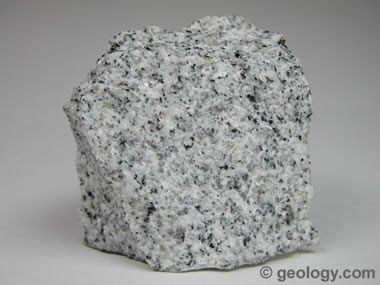
Granite is a coarse-grained, light-colored igneous rock composed mainly of feldspars and quartz; it also contains minor amounts of mica and amphibole minerals (see the accompanying chart titled Generalized Composition Ranges of Common Igneous Rocks). Once students know how to identify the minerals in granite, this simple description enables them to identify the rock based upon a visual inspection.
During that visual inspection, students should use a hand lens to confirm that the minerals of granite are present in the rock. That inspection would involve confirming that each of the minerals expected in granite is physically present in the rock – and present in the proper proportion.
Here is a summary of what you might observe on a broken surface of granite:
Feldspar Minerals
Feldspar minerals are abundant in granite. They are usually white, gray, pink or reddish in color. Many grains will exhibit two directions of cleavage that intersect at right angles. You should be able to observe this cleavage pattern in granite with a hand lens.

Quartz
Quartz will usually be a transparent mineral that is colorless or gray in color. Many grains will exhibit a conchoidal fracture – with a vitreous luster on the conchoidal fracture surfaces.
Mica Minerals
The mica minerals expected in granites include muscovite or biotite. Micas occur in very thin sheets. They will often be in “books” of numerous sheets stacked upon one another. The surfaces of these sheets will have a highly reflective vitreous luster. The edges of a “stack of sheets” will look similar to the edge of a stack of playing cards.
Amphibole Minerals
Amphibole minerals such as hornblende are dark in color and will often have a prismatic habit.
B) Petrologist’s Definition
Granite is a plutonic rock in which quartz makes up between 10 and 50 percent of the felsic components. Alkali feldspar accounts for 65 to 90 percent of the total feldspar content. Applying this definition requires the mineral identification and quantification abilities of a competent geologist.
This type of analysis cannot be done precisely by a student in a classroom or a geologist in the field. This is an example of the complexities that can be involved in assigning a formal name to an igneous rock.
Many rocks identified as “granite” using the introductory course definition will not be called “granite” by the petrologist. They might instead be alkali granites, granodiorites, pegmatites, or aplites. These names are for specific types of granite.
These names require a consideration of the grain size and the mineral composition of the rock – beyond determining that the rock is a granite. A petrologist might call these “granitoid rocks” rather than granites. There are many types of granite based upon mineral composition and texture.
The accompanying chart (Generalized Composition Ranges of Common Igneous Rocks) illustrates the range of granite compositions. From the chart you can see that orthoclase feldspar, quartz, plagioclase feldspar, micas, and amphiboles can each have a range of abundances.
C) Commercial Definition
Use of the word “granite” in the dimension stone and crushed stone industries is different from how the word is used by geologists. In these industries, the name “granite” refers to an igneous rock that meets the following criteria:
1) a rock with visible grains that interlock with one another
2) a rock that is harder than marble
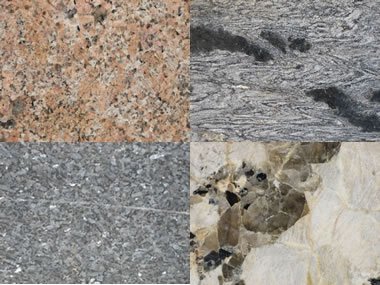
Using these criteria, gabbro, basalt, pegmatite, schist, gneiss, diabase, diorite, and many other igneous rocks will be called “granite.”
These “granites” are used to make crushed stone that is used for highway construction, concrete, building construction, fill, railroad ballast, and many other purposes. They are used in the dimension stone industry to make countertops, floor tiles, curbing, building veneer, monuments, paving stones, and many other products. These granites might be used with sawn, sheared, or polished surfaces.