Five categories of citrine exist in the gem and jewelry market. These are:
| 1. citrine with a natural color 2. citrine with a natural color, but enhanced by treatment 3. citrine produced by heating light amethyst 4. synthetic citrine (a man-made product) 5. imitation citrine (a man-made product that is not SiO2) |
All of these are legitimate products; however, sellers should always inform the customer when they are selling gems that have been treated, gems that might have been treated, and especially when they are selling synthetic or imitation materials. Here are a few reasons why…
Natural Color Citrine
Quartz with a natural citrine color is rare. Some people want this natural-color citrine and are willing to pay a premium price for it.
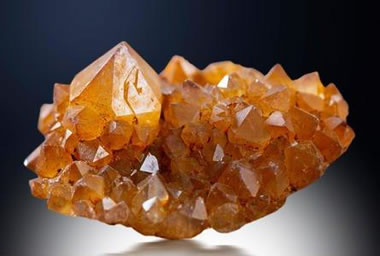
Citrine Crystals: A beautiful cluster of citrine crystal points with an orangy yellow color.
Heat-Treated Citrine
Long ago, someone discovered that some lightly colored citrine could be heated to improve its color. It was also discovered that some light-colored amethyst could be heated to produce an attractive citrine color. This treatment works exceptionally well and is inexpensive. Today, most of the citrine entering the gem and jewelry market is heat-treated amethyst mined in eastern Brazil.
Most people are satisfied with natural color citrine that has been color-enhanced by heat treatment, or citrine that has been produced by heating light-colored amethyst. Many people don’t even “think of” or “know of” these two possibilities. However, these are distinctly different products for some people. For that reason, a seller should inform buyers when the nature of the color is known, and honestly answer “we don’t know the origin of the color” when they cannot answer with certainty.
Synthetic Citrine
Synthetic citrine is a man-made material that has the same chemical composition, mineral structure, and optical properties as natural citrine. Much synthetic citrine with a wonderful color and exceptional clarity is grown in Russia using the hydrothermal method.
Synthetic citrine is inexpensive and available in consistent colors and can be made in unlimited quantities. It is the perfect material for manufacturing a consistent brand of jewelry for a retail merchant with hundreds of stores. It can be grown to produce gems of almost any size and color.
The “wonderful clarity” means that it has very few inclusions. Those inclusions are one of the most reliable ways to separate natural citrine from synthetic citrine. This makes it very difficult or impossible for a gemologist, working with traditional tools, to differentiate natural citrine from synthetic citrine. But, many gem laboratories have scientific instruments that can reliably separate natural citrine from synthetic. These tests can often be done for less than $100.
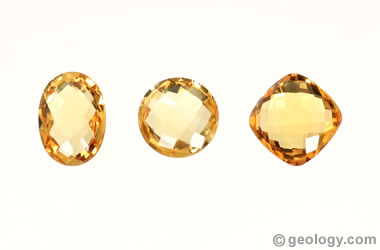
Synthetic Citrine: These gems were grown in a laboratory using the hydrothermal method and faceted with a checkerboard cut. The oval measures 14 x 10 millimeters, the round measures 12 millimeters across, and the square measures 14 millimeters from corner to corner.
Imitation Citrine
Although citrine and topaz are not extremely expensive gems, man-made look-alikes are often used as even lower-cost substitutes than synthetics. Lab-created corundum in a yellow to orange color is sometimes used as a citrine simulant in inexpensive birthstone jewelry.
Synthetic corundum has a Mohs hardness of 9 and is very durable. The only gem that is harder than corundum (the mineral of ruby and sapphire) is diamond – which is much less likely to be scratched or broken than topaz or citrine. Synthetic corundum is a good low-cost substitute for citrine if a person is willing to accept a material that simply “looks like citrine”.
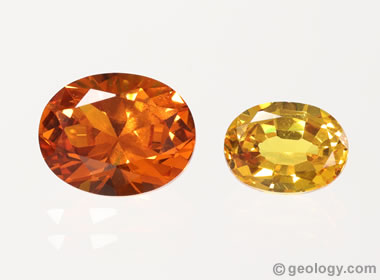
Imitation Citrine: Nanosital, a man-made glass-ceramic is often produced in colors that imitate citrine. The orange stone measures 10 x 8 millimeters, and the yellow stone measures 8 x 6 millimeters. Great color!