Earth’s mantle is thought to be composed mainly of peridotite. Some of the occurrences of peridotite on Earth’s surface are thought to be rocks from the mantle that have been brought up from depth by deep-source magmas. Ophiolites and pipes are two structures that have brought mantle peridotite to the surface. Peridotite is also found in the igneous rocks of sills and dikes.

Ophiolites: An ophiolite is a large slab of oceanic crust, including part of the mantle, that has been overthrust onto continental crust at a convergent plate boundary. These structures bring large masses of peridotite up to Earth’s surface and offer a rare opportunity to examine rocks from the mantle. Studies of ophiolites have helped geologists better understand the mantle, the process of seafloor spreading, and the formation of oceanic lithosphere.
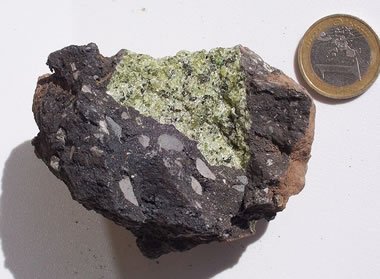
Pipes: A pipe is a vertical intrusive structure that forms when a deep-source volcanic eruption brings magma up from the mantle. The magma often breaks through the surface, producing an explosive eruption and a steep-walled crater known as a maar.
These deep-source eruptions are the origin for most of the Earth’s primary diamond deposits. The magma that forms the pipe is thought to ascend rapidly from the mantle, tearing rocks free from the mantle and from the walls of the pipe. These pieces of foreign rock are known as “xenoliths.” The diamonds are found in the xenoliths and in the residual material produced by their weathering. Xenoliths provide the only way that diamonds can ascend from the mantle to the surface without being melted or corroded by the hot magma.
Dikes and Sills: Dikes and sills are intrusive igneous rock bodies. Some of them are composed of peridotite that was sourced from deep within the Earth. When they are exposed by erosion, they provide another way that peridotite from great depth can be observed at Earth’s surface.