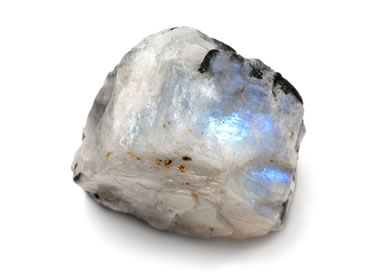
The most important job in cutting a moonstone cabochon is orienting the rough. This requires a knowledge of how light enters and behaves within the stone. The cutter must first identify the plane of adularescence. This plane will always be a parallel to a cleavage direction of the mineral.
Cleavage surfaces are then examined, looking for adularescence. Surfaces for one direction of cleavage will usually have much stronger adularescence than the other. Once that plane is identified, the flat base of the cabochon will be cut parallel to that plane. The cab should be approximately hemispherical in shape for a round stone, or a high loaf shape for an oval-cut stone.