“Herkimer diamonds” share most of the physical properties of other forms of quartz. They are almost always transparent and range from colorless to smoky in color. “Herkimer diamonds” are, by definition, doubly terminated; however, they are known to occur in a wide range of crystal forms (see illustration).
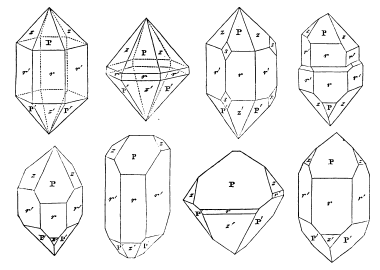
The crystals contain a wide range of inclusions. Particles of solid hydrocarbon materials are the most common inclusion. They range from small eye-visible particles down to micron-size particles, which, when abundant, can impart a smoky color to the crystals. Salt water and liquid petroleum are the most common liquid inclusions. Carbon dioxide is the most common gaseous inclusion. Calcite, dolomite, pyrite, sphalerite, and quartz (often in the form of tiny “Herkimer diamonds”) are common mineral inclusions.
| Physical Properties of “Herkimer Diamonds” | |
| Chemical Classification | Silicate |
| Color | Colorless to smoky |
| Streak | Colorless (harder than the streak plate) |
| Luster | Vitreous |
| Diaphaneity | Transparent |
| Cleavage | None – typically breaks with a conchoidal fracture |
| Mohs Hardness | 7 |
| Specific Gravity | 2.6 to 2.7 |
| Diagnostic Properties | Conchoidal fracture, glassy luster, hardness, double terminations |
| Chemical Composition | SiO2 |
| Crystal System | Trigonal |
| Uses | Sought by mineral and crystal collectors. Used to make natural crystal jewelry. Faceted for use in jewelry and as collector gems. Sold as a souvenir of Herkimer County, and collecting sites are promoted as tourist attractions. Frequently used as a talisman, amulet, or holistic gemstone. |