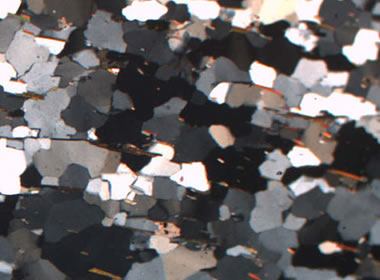
The interlocking crystalline structure of quartzite makes it a hard, tough, durable rock. It is so tough that it breaks through the quartz grains rather than breaking along the boundaries between them. This is a characteristic that separates true quartzite from sandstone.
Quartzite is usually white to gray in color. Some rock units that are stained by iron can be pink, red, or purple. Other impurities can cause quartzite to be yellow, orange, brown, green, or blue.
The quartz content of quartzite gives it a hardness of about seven on the Mohs Hardness Scale. Its extreme toughness made it a favorite rock for use as an impact tool by early people.
Its conchoidal fracture allowed it to be shaped into large cutting tools such as ax heads and scrapers. Its coarse texture made it less suitable for producing tools with fine edges such as knife blades and projectile points. Obsidian, flint and agate were better suited for tools where sharpness was important.