The pink color of rose quartz ranges from a very light, almost imperceptible pink, to a rich translucent pink. It is usually cut into cabochons, beads, and faceted stones of about eight millimeters in size or larger to display the rich pink color.
Some specimens of rose quartz contain a dense network of fine inclusions that align with the gem’s crystal structure. If a cabochon is cut so that its base is perpendicular to the c-axis of the quartz crystal, the cabochon might display asterism in the form of a six-ray star. The best star stones have a vivid pink color and a distinct, symmetrical, and well-centered star.
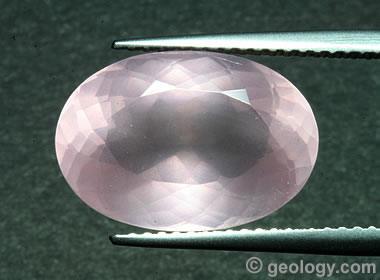
Faceted Rose Quartz: A faceted specimen of rose quartz cut from rough mined in South Africa. This stone was cut as an oval facet of about 15.09 x 10.44 millimeters and weighs about 7.42 carats.
| Physical Properties of Rose Quartz | |
| Chemical Classification | Silicate |
| Color | Pale pink to vivid pink. Sometimes zoned. |
| Streak | Colorless (harder than the streak plate) |
| Luster | Vitreous |
| Diaphaneity | Transparent to translucent |
| Cleavage | None, breaks with a conchoidal fracture |
| Mohs Hardness | 7 |
| Specific Gravity | 2.6 to 2.7 |
| Diagnostic Properties | Conchoidal fracture, glassy luster, hardness, pink color, translucence |
| Chemical Composition | SiO2 |
| Crystal System | Trigonal |
| Uses | Cabochons, beads, carvings, spheres |