Scapolite has an appearance that is very similar to many feldspars. As a result, it can easily be overlooked in the field and during hand specimen examination in a laboratory.
Massive scapolite is found in regionally metamorphosed rocks such as marble, gneiss, and schist. These massive specimens often exhibit a wood-grain or fibrous texture which facilitates their identification. Well-formed, gem-quality, prismatic crystals with a square cross-section are sometimes found in marbles.
In metamorphosed igneous rocks, especially gabbro and basalt, scapolite often occurs as complete or partial replacements of the feldspar grains. Crystals of scapolite are sometimes found in pegmatites and rocks altered by contact metamorphism.
Scapolite minerals are easily attacked by weathering. They are some of the first minerals attacked in their host rocks and easily alter to micas and clay minerals. As weathering begins, the mineral grains lose their transparency, become opaque, and have a reduced hardness.
| Physical Properties of Scapolite | |
| Chemical Classification | Silicate |
| Color | Colorless, white, gray, yellow, orange, pink, purple |
| Streak | White |
| Luster | Vitreous |
| Diaphaneity | Transparent to translucent |
| Cleavage | Good |
| Mohs Hardness | 5 to 6 |
| Specific Gravity | 2.5 to 2.7 |
| Diagnostic Properties | Luster, specific gravity, massive specimens often have a wood-grain or fibrous appearance, prismatic crystals have a square cross-section |
| Chemical Composition | A solid solution between marialite (Na4(AlSi3O8)3Cl) and meionite (Ca4(Al2Si2O8)3(CO3,SO4)) |
| Crystal System | Tetragonal |
| Uses | Faceted gemstones and cat’s-eye cabochons |
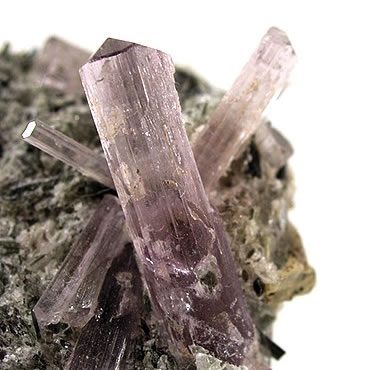
Scapolite crystals: Scapolite crystals of about 1 inch in length on matrix. Scapolite is one of a small number of minerals that have crystals with a square cross-section. These light purple crystals were found in Pakistan.