Tanzanite is a pleochroic gem. Pleochroism is a physical property in which the material appears to be different colors when viewed from different crystallographic directions. Some specimens of tanzanite can be a distinct blue when viewed from one direction, and vary from violet to reddish when viewed from other directions.
The group of three photos on this page shows a tanzanite crystal viewed from three different crystallographic directions. Because each of the three directions exhibits a different color, this makes tanzanite a “trichroic” material.
Pleochroism complicates the cutting process of tanzanite but also presents opportunity. The color of a finished stone will vary depending upon how the table of the stone intersects the crystallographic axes within the rough.
The top color for tanzanite is a vivid blue. Cutters must examine each piece of rough and determine if they can cut it in an orientation that will yield a finished stone with maximum face-up blue color. If that is possible, they then determine if changing the orientation of the cut will yield a larger stone of second-quality color that will sell for a higher price.
Deciding how to cut tanzanite is an exercise in skill, knowledge, and price estimation. In the cutting of tanzanite, some of the most highly skilled employees examine the rough and plan how it will be cut to maximize color or value. The stone is then cut into a preliminary shape – known as a preform. That is the step where value is gained or lost. It must be done carefully and with a high level of skill for every important stone.
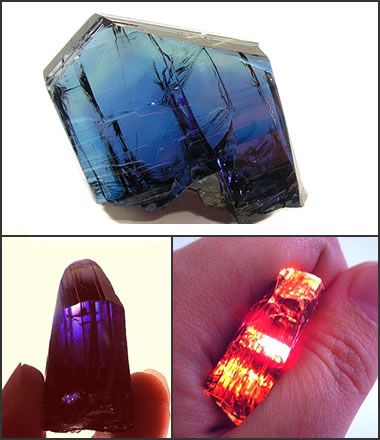
Pleochroism in tanzanite: These three photos show the same crystal of tanzanite viewed from three different crystallographic directions. They display the pleochroic properties of the gem. Pleochroism occurs when a gem appears to be different colors when viewed from different crystallographic directions. This specimen is trichroic – it appears to be different colors from three different directions. Looking at the broad side of the crystal, the gem has a wonderful blue color. When viewed from the narrow side, the specimen is deep violet. And, when viewed down the vertical axis with illumination below, it exhibits a reddish color. Those are the three pleochroic colors and three crystallographic directions for this specimen. This specimen has not been heated. Heating could strengthen the blue color and reduce the pleochroic effect.