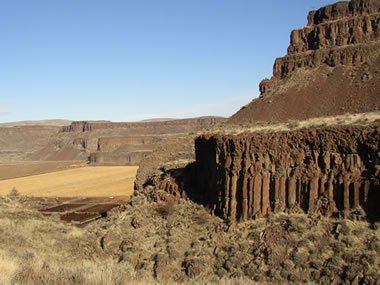
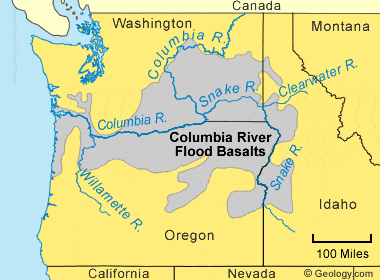
The third basalt-forming environment is a continental environment where a mantle plume or hotspot delivers enormous amounts of basaltic lava through the continental crust and up to Earth’s surface. These eruptions can be from either vents or fissures. They have produced the largest basalt flows on the continents. The eruptions can occur repeatedly over millions of years, producing layer after layer of basalt stacked in a vertical sequence (see outcrop photo).
The Columbia River Flood Basalts in Washington, Oregon, and Idaho are an example of extensive flood basalts on land (see map below). Other examples include the Emeishan Traps of China, the Deccan Traps of India, the Keweenawan Lavas of the Lake Superior region, the Etendeka Basalts of Namibia, the Karroo Basalts of South Africa, and the Siberian Traps of Russia. (The word “traps” is derived from the Swedish word for “stairs,” which describes the outcrop profile of these layered basalt deposits, as shown in the outcrop photo.)
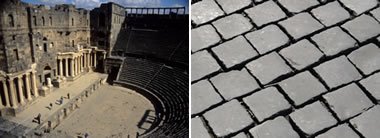
Basalt paving stones: (right) on a city street in Rome, Italy. Basalt pavers were often used in areas close to volcanoes.