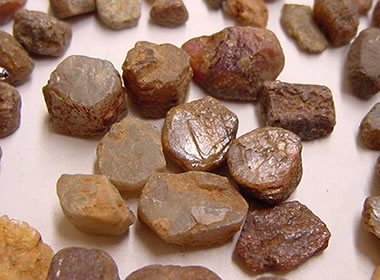
Corundum is an exceptionally hard and tough material. It is the third-hardest mineral, after diamond and moissanite. It serves as the index mineral for a hardness of nine on the Mohs Hardness Scale.
Its hardness, high specific gravity, six-sided crystals and parting are very good diagnostic properties to use in its identification. A summary of the physical properties of corundum is given in the table below.
| Physical Properties of Corundum | |
| Chemical Classification | Oxide |
| Color | Typically gray to brown. Colorless when pure, but trace amounts of various metals produce almost any color. Chromium produces red (ruby) and combinations of iron and titanium produce blue (sapphire). |
| Streak | Colorless (harder than the streak plate) |
| Luster | Adamantine to vitreous |
| Diaphaneity | Transparent to translucent |
| Cleavage | None. Corundum does display parting perpendicular to the c-axis. |
| Mohs Hardness | 9 |
| Specific Gravity | 3.9 to 4.1 (very high for a nonmetallic mineral) |
| Diagnostic Properties | Hardness, high specific gravity, six-sided crystals sometimes tapering to a pyramid, parting, luster, conchoidal fracture |
| Chemical Composition | Al2O3 |
| Crystal System | Trigonal |
| Uses | Historically used as an abrasive. Specimens with pleasing colors have a long history of gemstone use. |